


 Mustache Cups
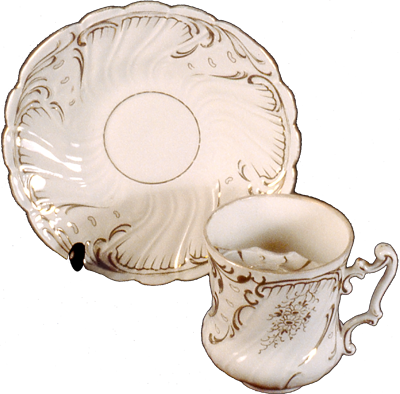
Mustache cups were popular from 1850 to 1900 when the large, flowing mustache was in style. A ledge of china or silver held the hair out the liquid in the cup. This kept the mustache tidy and also kept the mustache wax from melting.
Both right-handed and left-handed cups were available with the latter being the more expensive. Today these specimens are very scarce and very expensive. They were originally called Napoleons and Saucers, because men wore a Napoleon or small beard and mustache, following the Franco Russian War.
Mustache cups were sold as individual items in the beginning, but later were also sold with complete sets of tableware. Many collectors consider the French, German and/or Prussian mustache cups to be the aristocrats in the field. But the advanced collector searches for cups at Majolica, Imeri, Rose Medallion, Sunderland Luster and Belleek, or cups bearing Crown Derby and Wedgewood marks.
Free had painting as well as transfer printing and decalcomania was used. Mustache cups decorated with transfer designs are rather scarce, usually commanding high price when found. Mr. and Mrs. Cups are not considered to be rare nor command high prices. However, a matching left-handed and right-handed mustache cup is extremely rare. Numerous souvenir as well as commemorative cups were made.
Mustache cups were made in various sizes and shapes, including lip guard and handles. Many prefer to purchase market specimens because their origin can be traced, but this would leave unsold quantities of find old cups, many with marks that were washed off with age.
Almost all European potters market their wares (Germany, france, etc.). Beginnings in 1842 English items were required to be market. In1887 England forced all countries that wanted to trade with her to use a sigh of origin; in the U.S.A that began in 1891. Many mustache cups were made in Japan and have Nippon on them (sun origin) U.S cups were rarely market-those with a potter’s mark are rare. The early market American porcelain is often rarer than outstanding examples from other countries. Plated silver mustache cups are highly desirable but scarce.
It is difficult to find a mustache cup without some flaw-an imperfect cup has less artistic and monetary value than an undamaged one. Many defects in cups as well as the handles and rims on cups are most susceptible to breakage. Most collectors prefer to purchase matched sets (cups and saucers) when possible. An antique is anything made over 100 years ago but some of later mustache cups are classified as antiques by collectors and dealers because of their historical significance.
Shaving Mugs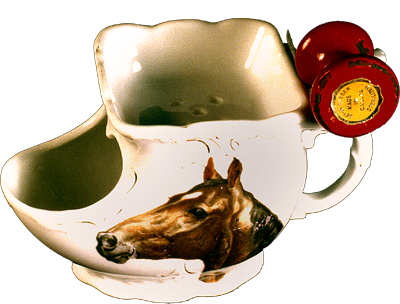
Shaving mugs were popular from 1860 to 1900. Many types were made, including occupation mugs featuring pictures of men’s jobs. There were scuttle mugs (a particular shape), silver-plated mugs, glass-lined mugs, and others.
Unpersonalized mugs were used in many countries over many centuries but personalized shaving mugs were popular in America- no other country had them. Burt Handelsman, a real estate investor in White Plains, N.Y. got the first of 500 mugs as a gift from his fiancée, now his wife. They were popular as gifts. Mug collectors seek designs or scenes that indicate the occupations (600) of the mug owners-such as a lawyer talking to the jury, a doctor, etc. Mugs are highly prized if they have all the desired collectible attributes: owner’s name, a symbol of his occupation, and his photograph.
The mug itself began as pure white pottery, imported ready-made but unadorned from Europe. Most mugs of American porcelain were considered inferior.
The artists who did the paining and lettering are for the most part anonymous- only occasionally is a signature found, and it usually adds little to the value. Real gold was used for lettering and decoration. It was customary once a year to burn the rags the artists used to wipe their brushes. All artists in an establishment shared in the value of the gold recovered from the ashes.
The decline of the shaving mug is the early 20th Century took place rapidly. One cause was the introduction of the safety razor and disposable blade by King Camp Gillette in 1903. Personal shaving became even more common after World War I, when servicemen had to shave themselves. Finally the spread of blue laws forced Sunday closings and lessened the social function of the barbershop, for which the Sunday trade had been important. But by the 1930’s collectors had already begun to seek out those hidden in attics or barbershops, and they are still at it.
Most concentrate the searching in the major Eastern cities, particularly in New England, and Missouri, Illinois and Kansas.